Restoring the Double Buffer: Six Months of Peatland Restoration at the BUFFER+ Donegal Pilot Site
From slowing water and stabilising eroding peat to training local stakeholders, testing restoration techniques and welcoming 50,000 new winged residents, the first six months of activity at the Interreg NWE BUFFER+ demonstration site in Glenveagh National Park show that peatland restoration is about much more than simply blocking a drain.
Take a visual tour of the project’s progress from March to August 2026.
27/10/26
History & Context
Across North-West Europe, peatlands have been drained, cut, planted, farmed and otherwise modified over generations. When peatlands lose water, they also begin to lose many of the functions that make them so valuable: storing carbon, regulating water and supporting highly specialised habitats.
That challenge is at the heart of Interreg NWE BUFFER+ (BUFFER Carbon + Water in Peatlands), a €9.7 million collaboration involving 21 partners and seven associated organisations across five EU countries. Through project pilots, the BUFFER+ project is demonstrating different ways of restoring the ability of peatlands to act once again as a natural double buffer for both carbon and water, while supporting biodiversity and exploring how restored wet landscapes can work for people too through new business models!
In Ireland, one of those pilots is taking place high in the blanket-bog landscape of Glenveagh National Park in County Donegal, where The Rivers Trust is delivering the project in collaboration with Glenveagh National Park.
A demonstration site for blanket bog restoration
Ireland contains some of the most extensive blanket bog habitat remaining in the world, and Glenveagh's bog and upland habitats form an important part of that natural heritage.
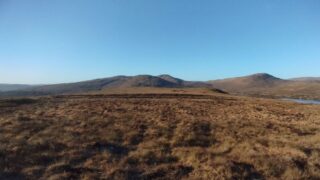
The BUFFER+ pilot site covers approximately 7.3 hectares, with restoration interventions concentrated across around 2.3 hectares in Glenveagh National Park.
At first glance, the site already supported characteristic bog vegetation and wildlife. The problem was more subtle. Historic drainage, erosion and damaged peat surfaces had altered the way water moved through parts of the bog. Deep, exposed peat banks and erosion features allowed water to leave the system quickly, while areas of bare and unstable peat were vulnerable to continued deterioration. Invasive plants, including rhododendron and prickly heath, presented an additional pressure.
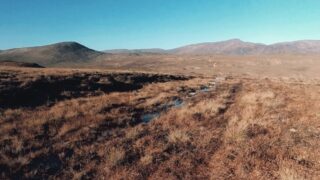
For The Rivers Trust’s BUFFER+ team, that made the site particularly valuable. Rather than restoring one large uniform area using a few single techniques, the site contained a range of common blanket-bog restoration challenges within a relatively compact area.
It offered an opportunity to demonstrate different interventions side by side, see how they perform in real conditions and use the landscape as a practical learning site for others involved in peatland management.
This is what we mean when we describe our pilot site as a “living classroom.”
Reading the bog before restoring it
Before machinery arrived, one of the most important pieces of work took place on foot and at the desk.
First, satellite imagery and aerial photography to understand the site from above and run some analysis, before heading onto the bog to ground-truth it through peat probing, hydrological mapping, habitat surveys and mapping drains and erosion features.
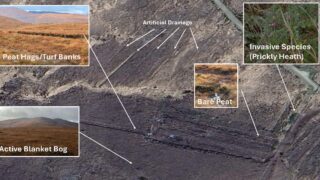
Once you are standing on the peat, subtle changes in topography, vegetation and hydrology can completely change the most appropriate intervention. A peat dam may work in one location; a timber structure may be more appropriate in another. An eroding face might need reprofiling, while a badly destabilised surface might require coir geotextile to protect it while vegetation re-establishes.
That ability to adapt was an important part of the project. The objective was not to impose engineering onto the bog, but to understand how water was moving through the landscape and intervene only where necessary to help restore more natural processes.
This information was brought together into a Restoration Action Plan, setting out the key pressures on the site and the most suitable measures to restore its hydrology and stabilise eroding peat. We used the Blanket Bog Restoration Toolkit created by the Wild Atlantic Nature LIFE IP and WaterLANDS Projects, and the Peatland ACTION Technical Compendium by NatureScot to inform our process.
From there came the less visible but equally important work of securing planning/ & impact permissions, completing the necessary assessments and tendering the restoration works.
After a competitive tendering process, RSPB Nature Regen Ltd was appointed to undertake the restoration works. Once the appointment was confirmed, the contractor, NPWS and the project team revisited the site in early March 2026 to review each restoration feature on the ground and agree the most suitable techniques for implementation. Physical restoration works subsequently commenced in March 2026.
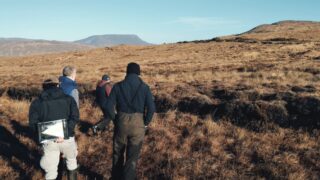
Putting restoration into practice, first up Hydrological Restoration
Across the site, a combination of timber dams and plastic dams were installed to interrupt artificial drainage pathways to slow the flow of water and reduce erosion of peat by the water.
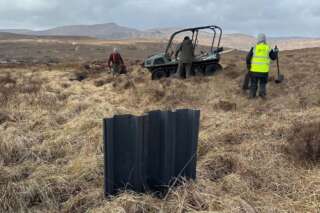
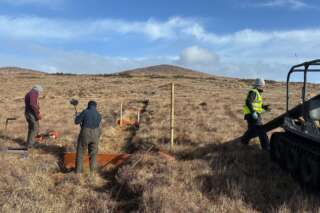
Peat was also carefully manipulated through techniques including zippering, wave dams and peat dams, closing pathways through which water and peat could continue to be lost. These interventions have a simple objective: keep more water in the bog, for longer.
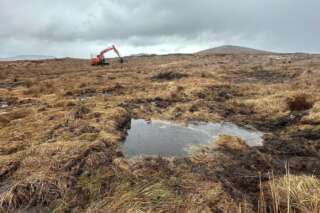
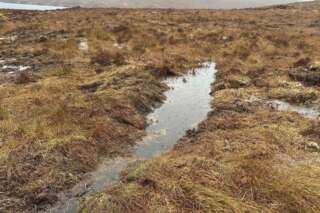
Healthy peatlands depend upon persistently wet conditions. Slowing drainage helps raise and stabilise the water table, reduces erosion and creates the conditions in which peat-forming vegetation can recover. This is the “buffer” at the centre of BUFFER+: restoring the landscape's ability to hold water during wet periods (reducing that peak flood flow) and retain moisture when conditions become drier (reducing drying during drought and fire risk periods).
And we did not have to wait long to see the physical effect.
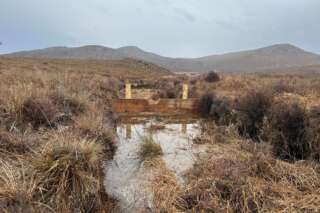
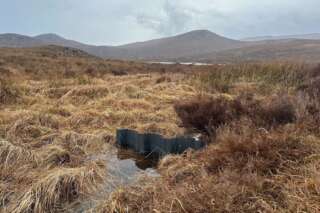
Heavy Donegal rain arrived almost immediately after some of the structures were installed. Within a day, water was visibly backing up behind newly constructed dams rather than rapidly disappearing downstream.
It was an early and very tangible indication that the hydrology of the site was already beginning to change.
Tackling erosion – without fighting the landscape
Not every part of the site could be addressed through drain blocking. Erosion control also plays an important role.
Approximately 240 metres of eroding peat edges and banks were reprofiled, reducing steep exposed faces and creating gentler, more stable slopes on which vegetation can recolonise.
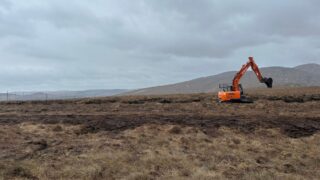
On one particularly vulnerable slope, flowing water and exposed peat had created an erosion problem requiring a different combination of measures. Here, 14 coir logs were positioned across the slope to interrupt surface flow, reduce erosive energy and help trap mobile peat and sediment.
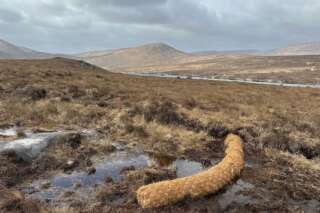
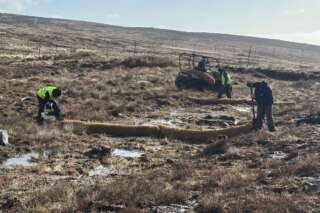
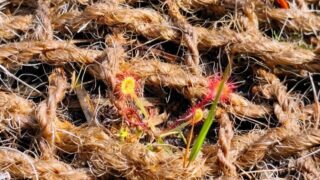
We also installed around 350 square metres of biodegradable coir geotextile over areas of vulnerable reprofiled peat. This geotextile does not “restore” the bog itself. Instead, it temporarily protects the peat surface from rain, wind and overland flow while vegetation begins the much slower process of recolonisation and stabilisation.
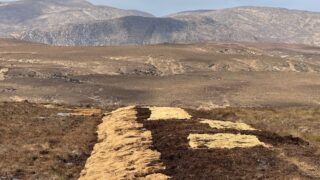
Further downslope, a few mini stone dams were installed to provide additional erosion control and sediment capture.
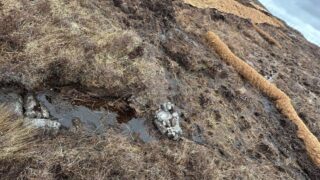
Making space for native bog vegetation
In addition to hydrological and erosion management, invasive species control plays an important role. Areas of rhododendron and prickly heath were identified within and around the demonstration site. Left unmanaged, invasive plants can spread into peatland and heath habitats, compete with native vegetation and make future habitat management increasingly difficult.
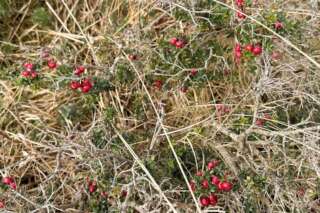
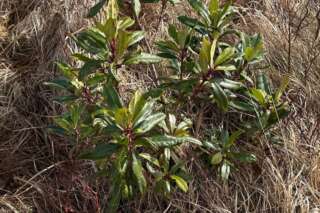
Targeted control is incorporated into the management of Glenveagh National Park by NPWS and on this site where targeted treatment on invasives takes place.
The intention is not to manufacture a particular appearance. It is to reduce pressures and allow the characteristic bog community – from Sphagnum mosses and cotton grasses to heathers and other wetland plants – to respond naturally as conditions improve.
From restoration site to living classroom
Completion of the physical works was not the end of the Glenveagh pilot.
In many respects, it was the beginning.
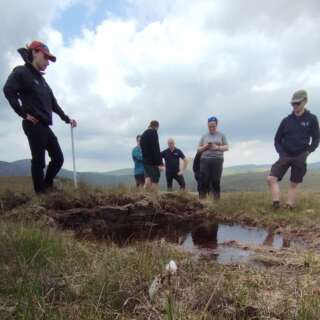
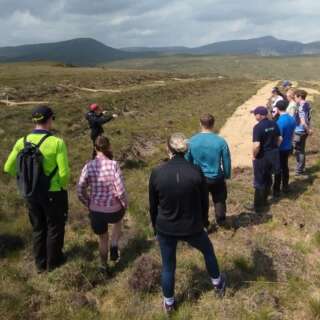
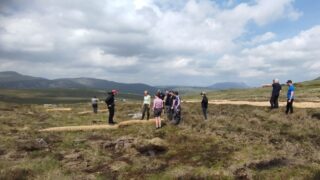
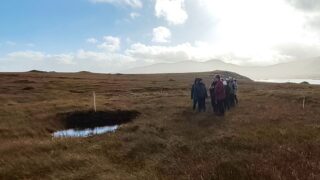
Through May and June, we were met with great weather and long sunny days and were able to engage in various activities, making full use of the Interreg BUFFER+ pilot site in the Glenveagh National Park as a “Living Classroom”. We participated in the Le Chéile don Dúlra (Together for Nature) Festival on Natura 2000 Day run by Glenveagh National Park. The festival highlighted the landscape, its history, people, nature and conservation, with a special emphasis on the arts. We showcased our restoration site at the Peatland Training Programme run by The Crichton Carbon Centre on behalf of LIFE IP Wild Atlantic Nature. The focus of the training programme was on peatland restoration design, planning and best practice techniques. Donegal ACRES CP have brought numerous farmers to the site to showcase the various interventions that can help restore peatland on their farms, and we also hosted DAFM advisors training with them. These events have provided a platform for knowledge exchange between various organisations involved in peatland restoration. Everyone involved generously shared their collective wealth of knowledge and passion for protecting our peatlands.
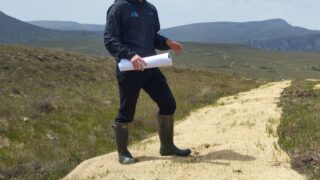
Earth Day, celebrated annually on 22 April, highlights the importance of clean air, safe water, and climate resilience, all of which are supported by healthy peatlands through their ability to store carbon, reduce flood risk, filter water, and protect biodiversity and cultural heritage. We chose to mark this significant occasion by announcing the successful completion of this important restoration work.
A new kind of monitoring arrives – with wings
Towards the end of June, things really started to buzz, in the most literal sense, with the arrival of two honey-bee colonies, each containing around 25,000 bees.
The hives were introduced to Glenveagh as part of our cross-cutting Beeodiversity monitoring pilot at the demonstration site.
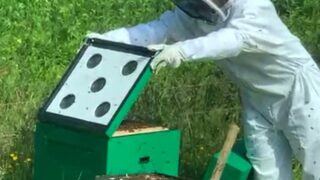
Our Project Manager, Barry, trained as the project beekeeper and sourced locally bred Native Irish Honey Bee (Apis mellifera mellifera) through the Inishowen Beekeepers Association and BoomTrees Bees, supporting wider efforts to conserve locally adapted honey-bee populations in Inishowen. Hive management is deliberately low-intervention and conservation-focused, allowing the colonies to develop as naturally as possible while also contributing to environmental monitoring.
During the summer, pollen traps were fitted to the hives to routinely collect a small representative pollen sample. These samples will then be analysed for indicators such as plant diversity, invasive species and environmental pollutants, providing both positive and negative indicators of peatland and wider landscape health.
In this way, the bees effectively act as tiny eco-drones. As worker bees forage across the surrounding landscape, travelling up to 3km from the hive, they continuously collect pollen from the plants they encounter, giving us a unique picture of what is flowering and present across the wider area.
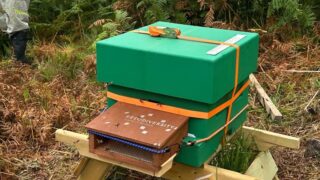
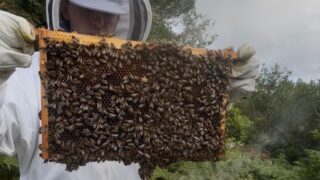
By August, both colonies had established well in their new Glenveagh surroundings and had expanded substantially, providing a promising foundation for the Beeodiversity monitoring pilot. Data collected will help to inform conservation and management practice.
Life on the Bog
Perhaps one of the most enjoyable parts of working on the site has been simply watching what uses it.
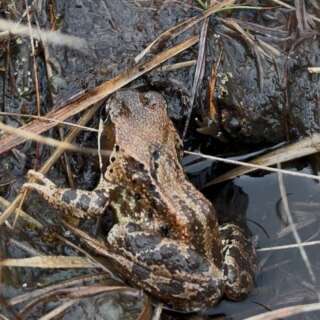
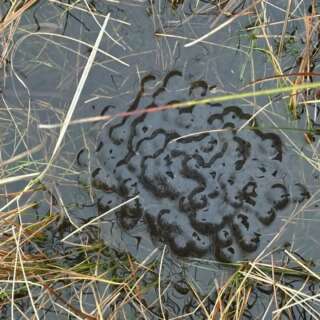
Frogs and frogspawn have already been recorded around wet areas, while red grouse, red deer, common lizards and birds of prey are among the wildlife observed on the site.
The small pools developing behind restoration structures are particularly interesting. Their purpose is primarily hydrological, but as water returns to previously drained pathways these wet features also introduce new microhabitats across the bog. Over the coming seasons, monitoring their colonisation by aquatic invertebrates, bog plants and species such as dragonflies and damselflies will form part of understanding how the site develops.
There will not be an overnight transformation. Some of the most meaningful changes may initially be almost invisible: a water table remaining higher through a dry week; less peat being washed from an eroding bank after heavy rain; Sphagnum beginning to expand across a wetter surface.
Those small changes are how functioning bog begins to rebuild itself, capture carbon, and regulate water.
Six months in – and just getting started
Between March and August 2026, the BUFFER+ Donegal Pilot in Glenveagh National Park has moved from restoration planning to implementation, early monitoring and active demonstration.
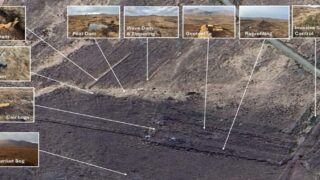
We have blocked drains, constructed peat, timber and piling dams, reprofiled eroding peat, stabilised vulnerable surfaces, installed coir logs and geotextiles, controlled invasive species and begun monitoring how the landscape responds.
But perhaps the most important outcome so far is that the site is already doing what a demonstration pilot should do.
It is bringing people onto the bog.
It is prompting questions.
It is allowing techniques to be examined in the landscape rather than just described in guidance.
And it is creating a place where farmers, practitioners, conservationists, researchers and land managers can share experience and learn from both the successes and the uncertainties that are an unavoidable part of ecological restoration.
Across North-West Europe, BUFFER+ is exploring how healthy peatlands can once again act as buffers for water and carbon, while supporting biodiversity and more resilient landscapes. Glenveagh is one relatively small piece of that much larger European experiment. Here in Donegal, the physical restoration work may be largely complete. The much longer process of watching, measuring, learning and allowing the bog to recover has only just begun.
For more information or to get in touch, please feel free to contact:
Barry McLaughlin: Project Manager (Peatlands & Nature-based Solutions)
Or
Shereen Rogers: Project Communications Officer
The Donegal BUFFER+ pilot is delivered by The Rivers Trust through the Interreg North-West Europe BUFFER+ project, with co-financing from the National Parks and Wildlife Service and support from Glenveagh National Park, Inishowen Rivers Trust and project contractors and collaborators.
Special thanks to the National Parks and Wildlife Service and the Glenveagh National Park team for their continued support, expertise and access to the site, and to RSPB Nature Regen Ltd for delivery of the restoration works. And a thank you to our local collaborators like Wild Atlantic Nature, ACRES Donegal, and Beeodiversity.