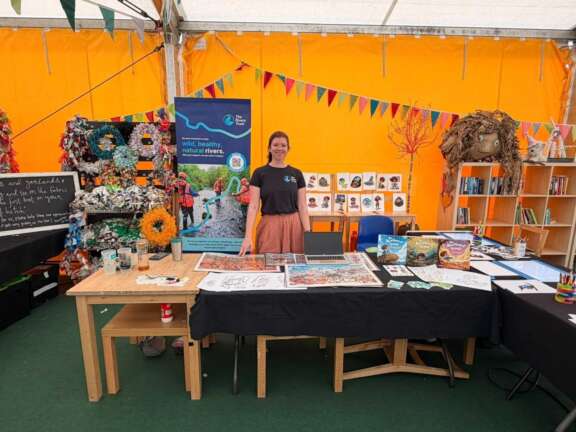
The Rivers Trust at Hay Festival – connecting families with river health through storytelling and crafts
Does fuzzy felt have a role in river restoration? Yes, argues Rebecca Duncan! It’s a sure-fire way to begin inspiring the next generation of river champions.
19/06/26
Blog
Rebecca Duncan, Events & Media Lead at The Rivers Trust, reflects on bringing the magic of rivers to life through in-person events, children’s books, and the medium of felt.
On 29th May, I returned to the picturesque village of Hay-on-Wye as The Rivers Trust supported the Make & Take children’s craft activities for a third successive year, and a fourth year of being involved in the festival more widely. I was also excited to be joined once again by Nick Parker, author of The Adventures of Scout books – the main character of which is The Rivers Trust’s first and only virtual Ambassador
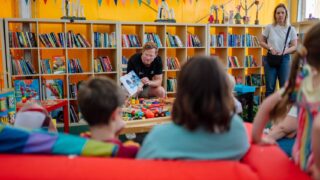
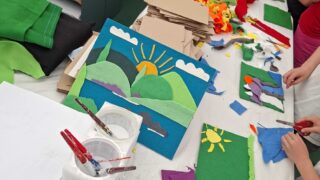
Organised by the festival’s Creative Engagement Manager Aine Venables and artist Sarah Morton, the Make & Take tent is a haven of creativity, providing numerous activities for children of all ages to explore freely over the course of three drop-in sessions. As we support Make & Take for one day of the festival, all the activities on that day are river and water-themed. From Scout-inspired crafts like collaging or using lightboxes to trace characters, to more general water-themed options like creating river scenes with fuzzy felt or shoebox dioramas, it’s easy to see why over 300 children attend.
Though it was tempting to spend all day with the fuzzy felt, Nick and I had a slightly more serious mission for the day, which was to harness the children’s energy and engage them – and their adults – on our river restoration and advocacy work and its importance. Nick is an engineer by trade who designs submarines, so brings a keen interest in the importance of STEM to the cultural world of Hay Festival. Inspired by the first Adventures of Scout book Stop Dropping Litter, he designed science experiments with buoyancy and density to demonstrate the impact of litter on waterways. Most children and many adults are somewhat blown away when an egg sinks in one cup of water but floats in another.
Science is, of course, of key importance to us at The Rivers Trust, but successful engagement is also about storytelling. Whilst some attendees were most enthused by Nick’s experiments, many others were interested in discovering Scout and her friends through the books themselves. The most popular activity of the day was our ‘Find Vinnie’ activity, inspired by the upcoming Find Vinnie book (Think: Where’s Wally? but with more frogs). With five different nature-inspired settings to choose from to find Vinnie the frog and five of his friends, it was a fantastic way to have conversations with attendees about the environment and wildlife as they tried to get the fastest time and jump to the top of our leaderboard. In true Adventures of Scout fashion, the beautiful illustrations also contain subtle messaging about environmental issues – you may also spot a crab stuck in a plastic yoghurt pot or melting ice caps.
Trying to discuss serious topics like pollution and climate change can feel daunting when you’re competing with fun, messy arts and crafts, but that is exactly why The Rivers Trust, and indeed the environmental sector as a whole, should be present in these creative settings. In the education space, there are growing calls to recognise the importance of the arts alongside STEM. In the Rivers Trust Movement, we are increasingly talking about the role of storytelling in advancing our mission to not just improve rivers themselves, but also education and understanding around them.
In my opinion, there is no better way to start that mission than with young people, who are smart enough to know the natural environment faces a difficult future, but have the determination and enthusiasm to explore what they can do about it. In using arts and culture to introduce children to The Rivers Trust’s work, we are setting them on the path that makes that possible.
Join our newsletter
Sign up to receive our supporter newsletter and get monthly updates on our work, campaigns, news (and future competitions!) directly to your inbox.