Reflections on the last two months of Mainstreaming Nature-based Solutions in Northern Ireland
Katie Smirnova, from The Rivers Trust All-Ireland Team, reflects on the work undertaken as part of the Mainstreaming Nature-based Solutions project in Northern Ireland across September and October 2026.
29/10/26
The Mainstreaming Nature-based Solutions (NbS) Programme is funded through the Ofwat Innovation Fund and focuses on water quality and flow. Taking place across England, Wales and Northern Ireland, it aims to deliver greater value for society and the environment by enabling implementation of NbS as common practice. The Rivers Trust is delivering the Northern Ireland Regional Test, which has had a busy two months!
In early September, we gave a lightning talk at a water quality knowledge transfer event led by the Northern Ireland Environment Agency (NIEA). We identified new opportunities for collaboration and gained a better understanding of the NIEA Priority Catchments Team's work. They undertake catchment investigations of priority waterbodies and feed recommendations into the programme of measures across the River Basin Districts. They also refer issues and recommendations to other NIEA teams delivering integrated catchment planning, water quality inspections, pollution response and pollution prevention, freshwater monitoring and assessment, and agricultural regulation.
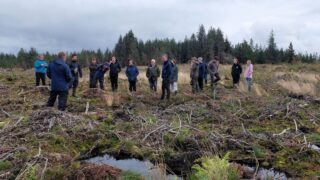
In mid-September, we visited a forest-to-bog restoration site with Ulster Wildlife and the Forest Service Northern Ireland as part of a Peatland Collaborative Network meeting. Drained peat soils degrade nearby surface water quality by releasing ammonium, fine-grained suspended sediments, and other pollutants. Drainage also creates new flow pathways for pollutants to reach waterbodies. Forest-to-bog restoration raises the water table through contour bunds and dams to improve site hydrology and reduce water pollution and carbon emissions. Tree felling, brash removal, mulching, stump flipping, and ground smoothing of forestry furrows are all techniques used by Ulster Wildlife which allow Sphagnum moss and other peatland species to recolonise the site. Sphagnum mosses are vital for healthy peatland functioning as they store water and under the right conditions, allow new peat to form. That site was particularly interesting due to its proximity to the pearl mussel population on Owenreagh River ASSI. This necessitated adapting the timing of restoration to avoid high rainfall periods and reduce sedimentation impact. Silt traps, silt fencing, sediment fencing on the water courses, and vegetated ground to buffer pollutants were used and monitored to avoid impacts.
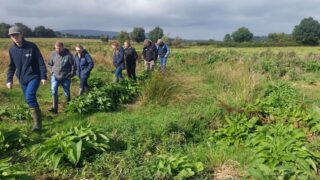
The following day, The Rivers Trust collaborated with the Ballinderry Rivers Trust on a talk and site visit about using swales to manage dirty farmyard water. Five low-cost swales were installed as part of the Water Innovation Network EIP Project (2020-2023), using comfrey and willow planting for bioremediation. These provide a harvestable crop which can be used for feed, fertiliser or biomass. Ballinderry Rivers Trust are now looking at doing further monitoring and installation of these swales on farms in a follow-on project. New challenges have emerged in this phase, and the Northern Ireland Regional Test will investigate these in a case study using the risk framework tools from the Mainstreaming NbS Programme.
In September and October, the Northern Ireland Regional Test also facilitated conversations between NI Water, Derry City & Strabane District Council, and Department for Infrastructure (DfI) Sustainable Drainage Directorate. The focus was on how SuDS feature in new developments, NI Water's mapping of stormwater separation opportunities, and learnings from DfI’s SuDS schemes in Belfast around ownership, maintenance and liability. These meetings were a starting point for further collaborative discussions related to the plan for Living With Water in Derry. The Rivers Trust also participated in an interesting meeting on this topic with the Lombard Street SuDS Partnership co-facilitated by Belfast Healthy Cities and the TalX2 team at Climate Northern Ireland. This partnership has been jointly developing a practical guide for monitoring and evaluating the co-benefits of nature-based climate adaptation.
Another interesting October event was an online webinar about leaky dams and sediment traps facilitated by the Northern Ireland Regional Test. Tony Fearon from the National Trust talked us through their project at Lisnabreeny and Cregagh Glen near Belfast. DfI saw potential for the site to slow the flow, and their consultants Jacobs and National Trust’s internal experts conducted site assessments to explore options. With DfI’s support and additional funding from DAERA towards access and recreation, leaky dams were built using larch felled on-site. This also allowed for replacement planting with native woodland in the glen. Native trees have recently been planted on grassy areas near the glen to intercept overland flow, but in the meantime, sediment traps have been built using earth banks, coir geotextile, and some filter stone to reduce pollution. The National Trust has considered public access to the site and has a plan for more community engagement to create co-benefits for recreation and nature connection.
If you’d like to get involved with the Northern Ireland Regional Test, please contact [email protected].